1930–1932
Hard times came first
Most Arkansas farmers depended on cotton when the Great Depression hit. Then the drought of 1930 burned up crops across the state. On January 3, 1931, hundreds of hungry farmers crowded into the town of England and demanded food.
In November 1930 a big Little Rock bank failed, and more than fifty Arkansas banks went down after it. Families who rented land or sharecropped had little to fall back on.
Sources: Encyclopedia of Arkansas: Great Depression · Encyclopedia of Arkansas: England Food Riot of 1931
1933
Put to work
Franklin Roosevelt took office in March 1933 promising action. Within weeks the Civilian Conservation Corps was signing up young men for work camps in the woods. The first Arkansas companies were in camp by that June.
That November, the Civil Works Administration started hiring people fast for short jobs: fixing roads, repairing schools and draining swamps to fight malaria, like this crew near North Little Rock. By January 1934 it had more than 80,000 Arkansans on the payroll.
Sources: Encyclopedia of Arkansas: Civilian Conservation Corps · Encyclopedia of Arkansas: Civil Works Administration
1934
A colony carved from swampland
In May 1934, Arkansas's relief program started Colonization Project No. 1 in Mississippi County. It was later named Dyess Colony after relief director W. R. Dyess. Nearly 500 struggling families moved onto 20-acre farms laid out around a new town center.
One of those families was the Cashes, who arrived in March 1935. Their son Johnny grew up in a Dyess colony house.
Sources: Encyclopedia of Arkansas: Farm Resettlement Projects · Arkansas State University: Historic Dyess Colony
1935
The WPA arrives
In May 1935 Roosevelt created the Works Progress Administration. By July it was hiring Arkansans off the relief rolls to build public projects. In June the National Youth Administration started paying young people to work and learn trades.
Many Arkansas children still learned in one-room buildings like this Ozark school. By 1943 the NYA alone had built 447 buildings in Arkansas, including 87 schools, 50 home economics buildings and 36 gyms.
Sources: Encyclopedia of Arkansas: Works Progress Administration · Encyclopedia of Arkansas: National Youth Administration
1936
Trouble on the land
In July 1934, Black and white sharecroppers near Tyronza formed the Southern Tenant Farmers' Union. Federal farm payments were supposed to be shared with tenants, but planters kept most of the money. Landowners pushed back hard, and in January 1936 union families near Parkin were evicted.
The Resettlement Administration, created in April 1935, tried a different answer: buy land and help families farm it themselves.
Sources: Encyclopedia of Arkansas: Southern Tenant Farmers' Union · Library of Congress: Parkin evictions, 1936 · Encyclopedia of Arkansas: Farm Resettlement Projects
1937
The great flood
In January 1937, weeks of heavy rain sent the St. Francis, White and other rivers over their banks. Thousands of Delta families were driven into Red Cross tent camps. Forrest City alone held about 15,000 refugees. Soldiers and volunteers cooked meals twice a day, and nurses gave typhoid and diphtheria shots.
That September the new Farm Security Administration took over the farm communities. Its photographers kept recording rural life, and many photos on this page are theirs.
Sources: Encyclopedia of Arkansas: Flood of 1937 · Encyclopedia of Arkansas: Farm Resettlement Projects
1938–1940
New farms, new parks
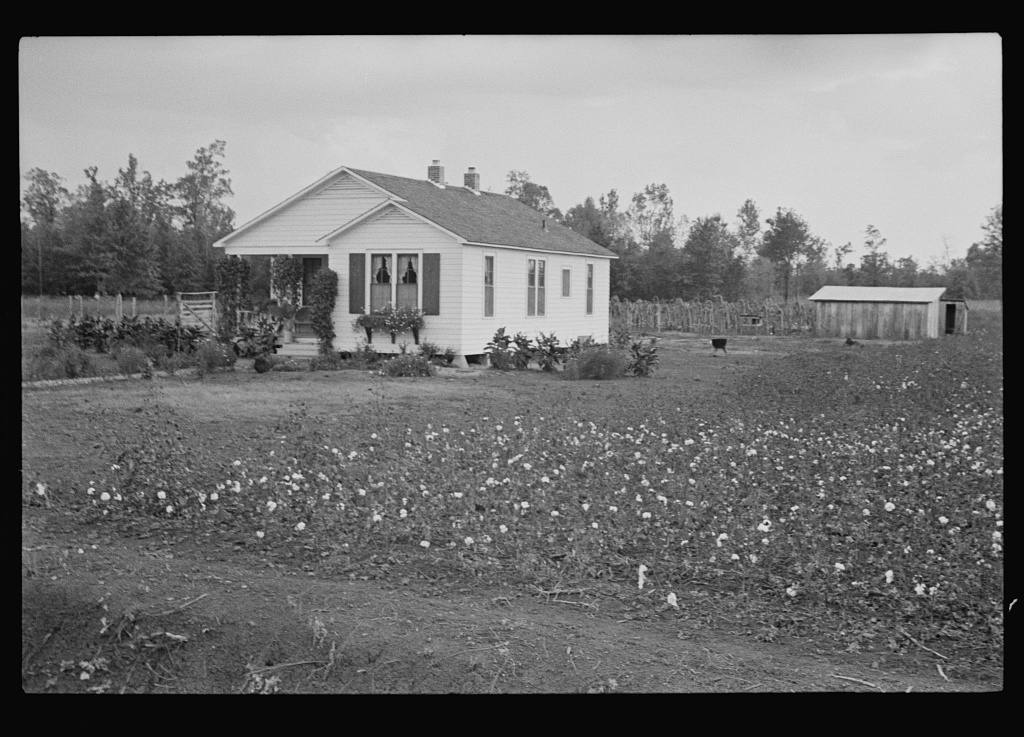
New farm communities like Plum Bayou, Lake Dick and Lakeview gave families homes with wells and barns. Lake Dick ran as a cooperative: families lived in one village and worked the fields together. Lakeview was built for Black farmers. Across the state, the CCC built stone lodges, cabins and trails at six state parks.
In 1940 an FSA loan helped Faulkner County farmers open a community service center at Centerville, with a blacksmith shop where they could shoe their mules.
Sources: Encyclopedia of Arkansas: Farm Resettlement Projects · Encyclopedia of Arkansas: Civilian Conservation Corps · Library of Congress: Centerville community center, 1940
1938–1943
A mural in the post office
The Treasury's Section of Fine Arts held contests to paint murals for new post offices. Arkansas got 21 pieces of post office art between 1938 and 1943, showing cotton fields, sawmills, bauxite mines and town history. Nineteen survive.
Joe Jones painted “Threshing” for Magnolia in 1938. It now hangs in the Magnolia Public Library.
Sources: SAH Archipedia: Murals in Arkansas · University of Central Arkansas: Magnolia Post Office
1941–1943
Off to war
When the United States entered World War II, defense plants and the military needed every worker. Congress ended the CCC in 1942, and the WPA closed its books in June 1943 after spending almost $117 million in Arkansas.
Army engineers like these took over big jobs such as levee work on the White River. The New Deal work era was over, but what it built stayed.
Sources: Encyclopedia of Arkansas: Civilian Conservation Corps · Encyclopedia of Arkansas: Works Progress Administration · Library of Congress: White River levee, 1943