Red Cloud, Nebraska
Literary heritage
Willa Cather’s hometown connects preservation, philanthropy and local enterprise.
Fed report · pp. 26–29An economic road trip Oklahoma · 2026
Can an old road help small towns
build a new economy?
On Route 66, the answer begins with the people who give a passing traveler a reason to pull over.
Take the slow road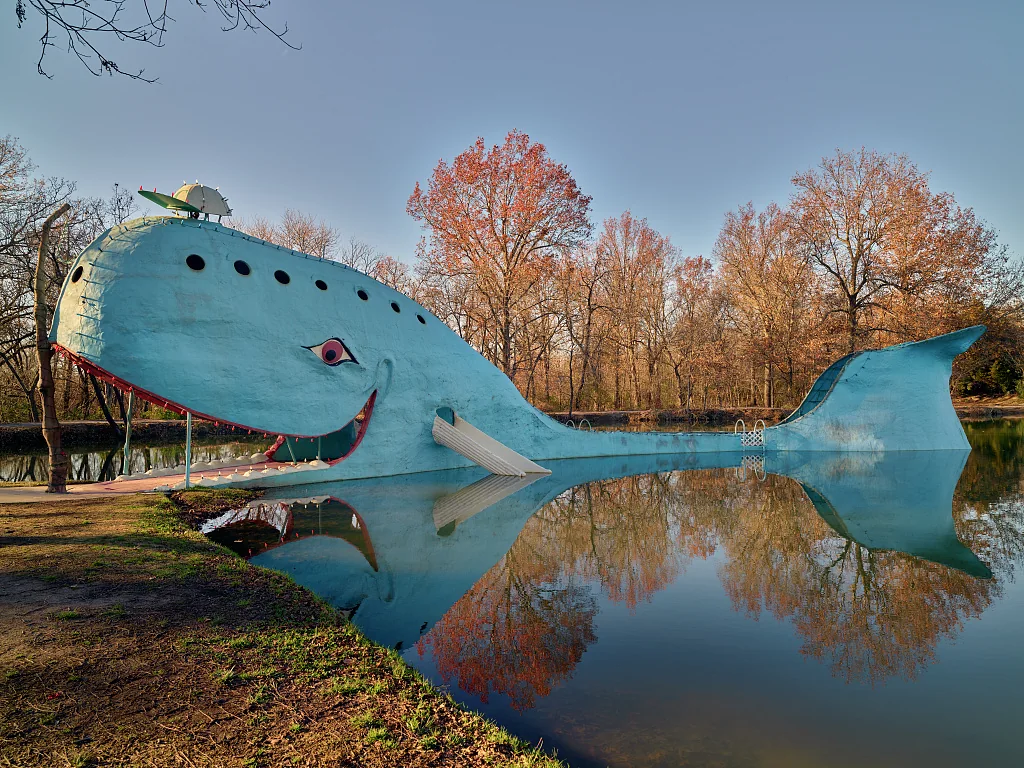
The road turns 100
Route 66 once carried travelers between Chicago and Southern California. A century after its designation in 1926, its old alignment links another kind of infrastructure: cafés, cultural centers, restored buildings and people determined to keep them going.
The Kansas City Fed followed that work through rural communities. Its report offers something more useful than a promise of prosperity: concrete examples of how a place becomes worth stopping for.
We’ll travel west across Oklahoma, where much of that reporting takes place. First, find the road.
Fed report · pp. 7–13, 20–2301 Miami
Eli Chenoweth was 19 when he bought an old Marathon station in 2018. He and Tori Chenoweth gave it a new job: a tiny place for travelers to stay.
Another station became their Frozen Elephant shaved-ice business. The buildings still look like reasons to stop. Now there is something to buy when you do.
Preservation needs a use that can keep the doors open.
Across town, volunteers helped bring the Coleman Theatre back to life. A business and a civic landmark require different kinds of support.
Fed reporting · pp. 52–6102 Vinita
Anna Mitchell helped revive traditional Cherokee pottery. A cultural welcome center bearing her name opened in 2022, creating a place for Cherokee art, history and gathering alongside the road.
The Cherokee Nation’s story does not begin with Route 66. The route brings people to a living culture whose members decide how to share it.
A community’s history belongs in its own voice.
Cherokee Nation · center and programsFed reporting · pp. 62–67A little farther west of town
At the Hi-Way Café and Western Motel, Beth and Alan Hilburn offer two reasons to linger: a meal and a bed. Referrals to other roadside businesses help a traveler find the next reason.
Individual offerings can become an itinerary through referrals and shared promotion.
Conceptual diagram. The report documents collaboration, not a measured increase in spending from these connections.
The café’s Giving Wall also lets people pay meals forward. A roadside business can serve travelers and neighbors.
Fed reporting · pp. 68–7303 Catoosa
Hugh Davis built the Blue Whale as an anniversary gift for his wife, Zelta, in 1972. Keeping a landmark alive proved to be a longer commitment.
After the swimming pond closed in 1988, local supporters took up restoration. City ownership in 2020 made stewardship a public responsibility.
Fed reporting · pp. 12–13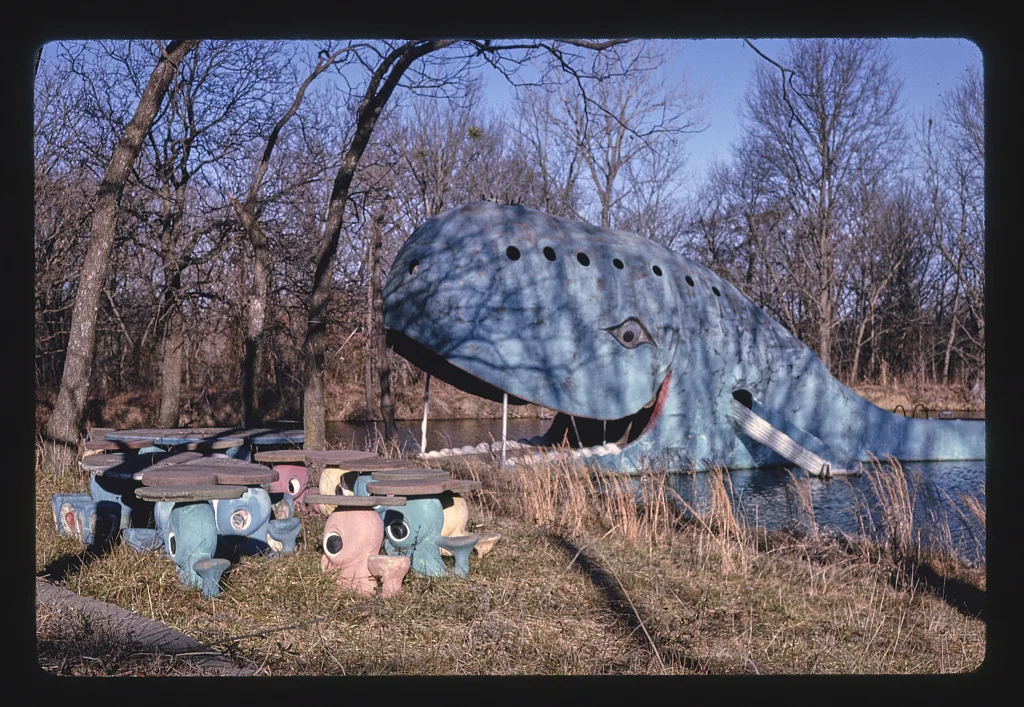
Different dates and viewpoints. These photographs document appearance, not economic impact or current conditions.
04 Near Luther
For Black travelers during segregation, a place to buy gas, eat and rest could also be a place of safety.
The Threatt family’s filling station offered that refuge. Descendants including David Threatt are working to preserve the site and tell the history themselves.
In 2023, young people from the Guthrie Job Corps helped restore its stonework and paint through the National Trust’s HOPE Crew program.
What gets preserved shapes whose road story gets told.
Threatt family · preservation projectFed reporting · pp. 84–8505 Arcadia
After the Round Barn’s roof collapsed, retired carpenter Luke Robison and a volunteer crew known as the Over-the-Hill Gang helped restore it.
The landmark survives because people supplied skills and time. Those are real inputs, even when they do not appear on a payroll.
Volunteer capacity is part of a place’s infrastructure.
Fed reporting · pp. 86–8706 El Reno
A former fuel station used for storage reopened as a visitor center in May 2025, with more than $1.2 million in grant support.
Tourism director Becky Riggs wants visitors to find their way around. Resident and city public information and marketing manager Lindsay Bayne sees something useful closer to home: a place for town halls, children’s activities and community life.
A visitor economy should make room for the people who live there.
Grant support is an investment figure, not a measure of visitor spending or financial return.
Fed reporting · pp. 92–9307 Clinton
Clinton already has a Route 66 museum. But a traveler can visit it, eat near the interstate and leave without ever reaching downtown.
Jason and Meridith Smith, architect Andrew Stone and the West OK Co-op have been working on that missing connection: reused buildings, shared creative space and a more visible invitation into town.
Fed reporting · pp. 74–83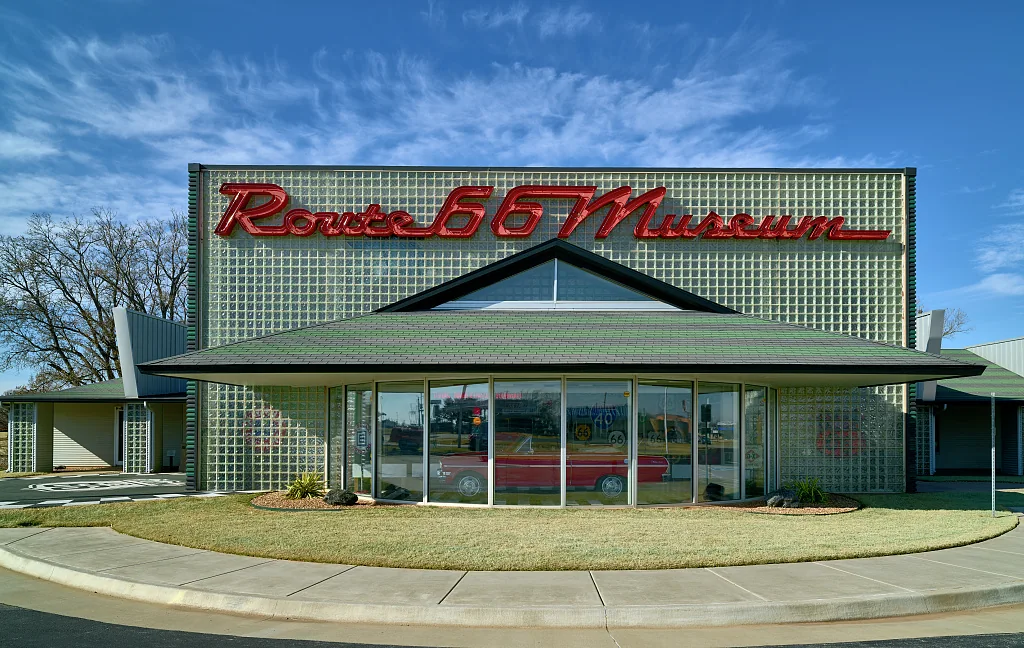
The last connection
Schematic, not a street map. The line explains the local strategy; it does not show measured traffic.
A July 2026 update found gateway organizers sourcing steel and navigating higher prices and approvals. Firehouse 66 is intended to serve visitors and community gatherings.
Funding starts a project. Construction, operation and local benefit are still work ahead.
Fed update · published August 202608 Sayre
Suzanne Hylton helped create Gallery@112 as a home for local art, sales and classes. The city supplied a building. Customers came from down the road as well as far away.
Asked where the sales came from, Hylton estimated:
Owner’s estimate reported in 2025 interviews. Not audited sales records, a visitor survey or a town-wide measure.
At 80, Hylton was also thinking about who would carry the work forward. A centennial can bring attention. It cannot supply the next organizer.
The hardest part may be keeping a good thing going.
Fed reporting · pp. 96–101An evidence stop
A 2011 Rutgers study estimated Route 66 activity across the corridor. It counted three different things. Only one was traveler spending.
The much larger economic-impact figure often repeated from the study includes modeled effects of all three. It is not a measurement of today’s tourism receipts in Oklahoma.
Historical estimates in reported study-period dollars. We make no inflation adjustment or current-year projection.
Traveler estimate draws on a 2009 survey of about 4,200 respondents. Main Street figure averages 2006–08 investment; museum estimate extrapolates operating budgets. Different activities and methods, not three measures of tourism.
Cited study · synthesis, pp. 9–13The view beyond Oklahoma
Route 66 is one case in a wider landscape. The Fed also found communities organizing around literature, music and open country. Each has its own institutions, market and constraints.
Red Cloud, Nebraska
Willa Cather’s hometown connects preservation, philanthropy and local enterprise.
Fed report · pp. 26–29Flint Hills, Kansas
A scenic route gives the prairie and its communities a shared frame for visitors.
Fed report · pp. 15–16Southwest Virginia
The Crooked Road connects music venues across a region. Regional tourism totals cannot isolate its effect.
Fed report · pp. 30–35Bring the question home
Start with something your community has. Explore a lesson from the road and a question to ask locally.
An editorial synthesis, not an economic-development score or a forecast.
Four lessons shown.
Who will operate the place after the restoration is finished? Which uses would serve residents as well as visitors?
Revisit MiamiWhose knowledge is missing? Who should decide how the place’s story is told?
Revisit VinitaWhich nearby businesses or institutions could refer people to one another? What keeps a visitor from reaching town?
Revisit the connectionsWhose time and skills keep things running now? How will another generation learn the work and share the decisions?
Revisit SayreThe road gets people here.
Distinctiveness can support an economy when people preserve it, put it to use and connect it to other places. These stories show how that work begins. They also show why it never really ends.
Back to the beginning ↑Keep the map open
Independent interactive exploration. Not produced, sponsored or endorsed by the Federal Reserve Bank of Kansas City.
Jennifer Wilding, The Byways Report: The Scenic Route to Rural Prosperity, Federal Reserve Bank of Kansas City, January 2026. The case stories above are original paraphrases of this reporting, based on a literature review, interviews with 31 people and site visits. Page references are printed report pages.
Report hub · Chapter summaries
New generations use Route 66 to revitalize historic Clinton, Oklahoma, August 24, 2026, including the July 2026 update. Grants are awards; no post-project economic outcome is inferred.
Cherokee Nation Anna Mitchell Cultural Welcome Center, official description; Path of Resilience, official 2026–27 exhibition listing. These describe a living cultural institution.
Threatt Filling Station, family preservation organization. The Fed provides the restoration details used here.
Rutgers, Route 66 Economic Impact Study: Synthesis of Findings, 2011; technical volume I; National Park Service study overview. The chart uses the study’s rounded annual direct-spending estimates, not its modeled total output.
Rutgers, Route 66 Revisited (2022): nearby household market potential is not observed visitor spending.
National Travel Center, The Economic Impact of Scenic Byways and Roads: its cross-byway dollars-per-mile heuristic is not used to estimate Oklahoma impact.
ACS five-year data and BLS QCEW were assessed for community context, not analyzed here. They cannot isolate Route 66 effects. Small-area uncertainty and employment suppression would require care.
Oklahoma Route 66 grants and FHWA America’s Byways were reviewed as grant and designated-route resources. No new totals or exhaustive map were derived.
The route selection, narrative connections, schematic maps and end questions are editorial interpretation. No independent causal economic analysis is presented.
The Sayre strip reproduces an owner’s estimated 50/25/25 sales mix. Rutgers bar widths divide each rounded amount by the largest category, $67 million. No inflation adjustment, forecast, distance-based estimate or simulated traffic is used.
Place positions are manually generalized for a narrative atlas. Stop numbers indicate reading order, not mileage. The national ending shows selected report cases, not all American byways. The continental US outline is derived reproducibly from Natural Earth 1:110m country geometry; Alaska, Hawaii and territories are outside this story’s geographic scope.
Blue Whale, December 5, 2020: Carol M. Highsmith, Library of Congress, LC-DIG-highsm-65553.
Blue Whale, 1995: John Margolies, Library of Congress, LC-DIG-mrg-03516.
Oklahoma Route 66 Museum, December 13, 2020: Carol M. Highsmith, Library of Congress, LC-DIG-highsm-65637.
Each catalog record states “No known restrictions on publication.” Images resized and compressed for the web; cover cropped for layout. No Fed photographs or third-party maps from the report are reproduced. The national outline uses Natural Earth public-domain map data; Route 66 and selected place positions are generalized editorial anchors.
The Fed’s cases are selected stories, not a representative sample or a causal evaluation. Interviews and owner estimates are attributed. Historic investment, grant awards, sales, visitor spending and modeled output describe different things.
Tourism does not replace every lost industry. Maintenance, access, resident uses and succession matter. Construction status and exhibits can change; research checked October 5, 2026. Archive photographs do not show current conditions.
An independent editorial adaptation built with semantic HTML, CSS, SVG and native JavaScript. The Scrollama project informed the scroll-story approach; no library code is imported. Motion can be disabled in the header. The full story remains readable without JavaScript.